
Contributor: CCF. Published for AMXNX readers.
The best carbon fiber front lip for a daily-driven BMW is one that suits the exact bumper, works with your usual routes and comes with clear installation information. Start with those three checks before choosing the most dramatic shape in a photograph.
A front lip can give an M2, M3 or M4 a more defined lower edge. But the car still has to enter your driveway, use parking garages and reach the workshop without an avoidable surprise. This guide helps you turn a style preference into a practical shortlist.

1. Identify your car and its current front bumper
Write down the model, model year and chassis generation before browsing. “BMW M4” is not a complete application description. Include any bumper replacement, existing corner pieces or suspension changes when asking about a product.
Take a straight-on photograph and a low side view of the front end. If an installer can safely provide a view of the relevant underside, that may help answer mounting questions. Do not crawl under an unsupported car to collect a photograph.
Start in the appropriate AMXNX collection: BMW G8X carbon fiber parts or BMW G87 M2 carbon fiber parts. Then check the selected product’s application rather than treating the collection name as confirmation for every item.
2. Consider forward projection as well as height
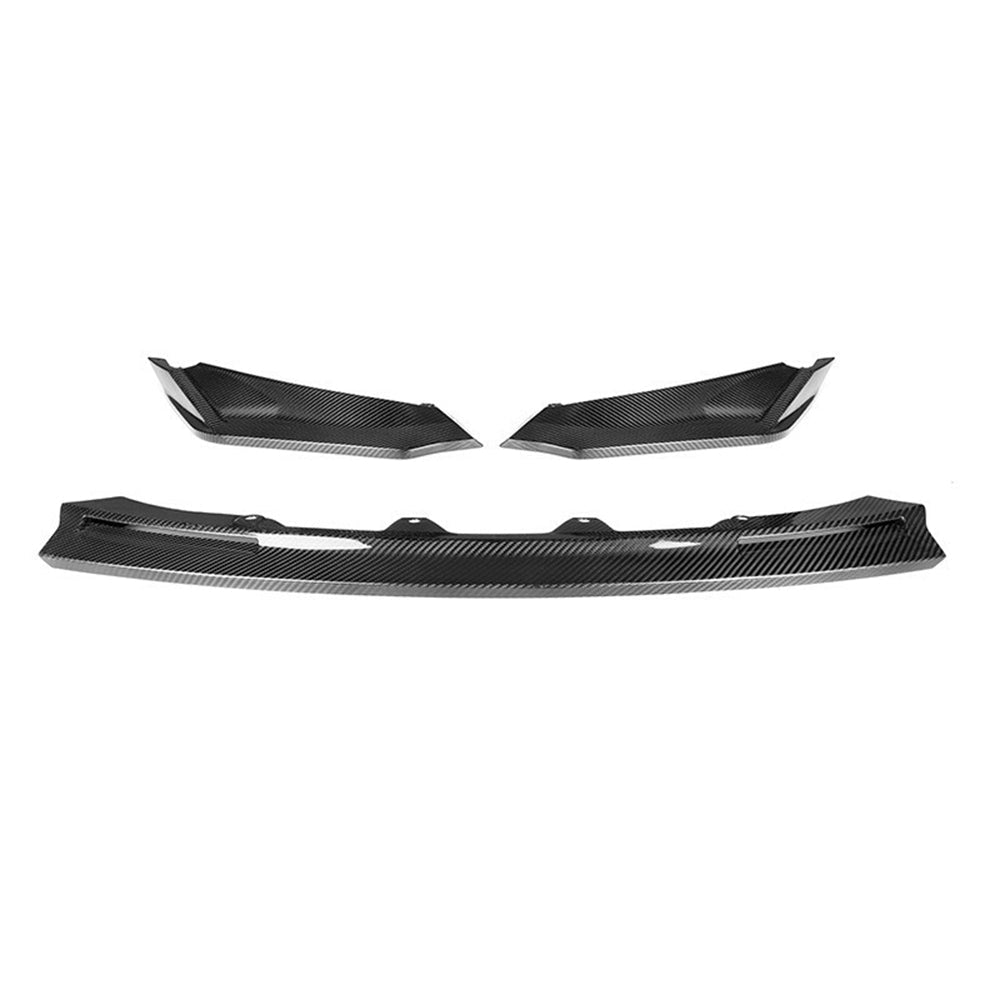
A lip’s lowest point matters, but so does how far it extends in front of the car. Two designs can create different approach-clearance concerns even when their lowest edges appear similar in a front photograph. A straight-on image is useful for styling; a side view is more useful for understanding the lower profile.
Ask for relevant dimensions or an installed side view of the exact reference. A picture of a different lip on a lowered car will not establish the clearance of your proposed setup. If dimensions are unavailable, keep that question open before committing to the purchase.
For a more detailed explanation of what an installer should record, see CCF’s front-lip clearance guide for lowered cars. Use it to structure the conversation, not as a universal minimum-clearance specification.
3. Think about the places you actually drive
Consider your steepest regular driveway, garage entrance, speed humps and parking stops. Describe the locations that already need care with your current bumper. Your installer can assess the proposed change against the car’s present configuration; no single static measurement guarantees clearance everywhere.
- Driveway or garage ramp: discuss the transition between the road and the slope.
- Parking stops: remember that a new forward edge may sit differently from the bumper you are used to.
- Lowered suspension: tell the seller and installer about the setup before requesting an application opinion.
- Changing passenger or luggage load: avoid judging everyday usability solely from an unloaded showroom photograph.
If the existing car already has difficulty on a regular route, resolve the proposed lip’s implications before ordering. A more subtle visual option may suit your routine better, but appearance alone cannot establish its clearance.
4. Check what the front-lip price includes
Identify whether the listing supplies one component, several sections or additional corner pieces. Ask which hardware is included and which existing components must be retained. A “three-piece” description explains quantity, but does not by itself promise that individual sections are available as replacements.
Keep a copy of the selected product page and the seller’s clarification with your order. If you change to another reference, repeat the unresolved checks instead of assuming the first answer applies to the new selection.
For the difference between a single component and a supplied set, see CCF’s guide to part and kit quantities. It can help you ask precisely what is included.
5. Price the installed result, not just the part
Ask your workshop to separate the part, delivery, removal of existing accessories, trial fitting and installation. Identify any optional finishing or related work before booking. This makes it easier to compare offers that initially look similar.
Trial fitting should happen before permanent changes. If the part or vehicle presents an unexpected issue, ask the installer to document it and obtain the product-specific next step. Do not assume that cutting, drilling or extra adhesive is an appropriate solution for every fitting concern.

If an adhesive is part of the documented method, your installer can use CCF’s adhesive-compatibility questions to identify the information needed. This does not prescribe an adhesive for every lip.
6. Choose the look after the practical questions are clear
Once you have a suitable shortlist, compare the outline, visible carbon area and how each reference relates to the rest of the car. If you prefer a restrained build, assess the complete front-end appearance rather than relying on an “OEM-style” label. If you prefer a stronger visual change, check the side profile as carefully as the front view.
A style name does not establish aerodynamic performance. If measurable downforce or weight reduction is a purchasing requirement, request evidence for the selected product and configuration. Carbon construction alone does not prove a particular benefit on your car.
Before ordering, read the actual seller’s warranty and returns terms. CCF’s warranty comparison guide explains useful questions about coverage and evidence; it is not a statement of AMXNX policy.
A message to send before ordering
I have a [model, model year and chassis] with [original or changed bumper] and [standard or modified suspension]. I am considering [product link]. Please confirm the application, supplied sections, mounting information and any available profile dimensions. I have attached front and side photos. My main concern is [driveway, garage entrance or other use].
This gives the seller more useful information than “Will this fit my BMW?” It also leaves you with a written record to share with the installer.
Frequently asked questions
Can I fit a carbon fiber lip to a daily driver?
It can be an option, but suitability depends on the selected part, vehicle configuration and everyday use. Confirm application, mounting and clearance considerations before choosing.
Does a more aggressive lip always sit lower?
No reliable conclusion follows from the style name alone. Check the actual profile, lowest point and forward projection of the selected reference.
Will dry carbon prevent scraping?
No. A construction label does not change the route your car must clear. Assess the installed shape and the vehicle’s setup independently of the material description.
Should I buy the lip before speaking to an installer?
When installation or clearance is uncertain, discuss the product with the workshop first. Confirm the service scope before scheduling the job.
Build your shortlist with AMXNX
Browse the relevant collection above, save the references you like and send your vehicle details to AMXNX on WhatsApp. Ask about the actual product you intend to buy so the next step is a clear selection, not another guess from a photograph.


Leave a comment
All comments are moderated before being published.
This site is protected by hCaptcha and the hCaptcha Privacy Policy and Terms of Service apply.